
NJ Pizza vs NY Pizza: What’s the Real Difference?
NJ Pizza vs NY Pizza: What’s the Real Difference?
People have been having this argument for decades, and it doesn’t seem to be going anywhere. NJ pizza vs NY pizza is one of those food debates that gets surprisingly heated for something that both sides agree is delicious. Walk into a pizzeria in New York and ask them which is better; then walk into a spot in Randolph or Morris Plains and ask the same question. You’ll get two very different answers, both delivered with complete confidence.
The honest answer is that they’re genuinely different things. Not better or worse in some objective sense, but built differently, seasoned differently, and eaten differently. Understanding what actually separates them is more interesting than just picking a side.
The Crust: Where the Debate Usually Starts
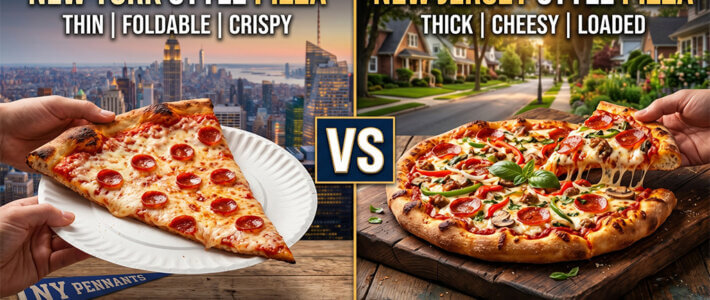
NY pizza is known for its thin, pliable crust. Wide slices, foldable down the middle, a slight crispiness on the bottom that gives way to a chew. The fold is practically a ritual at this point. You see someone fold a slice in New York, and it signals something about how they eat pizza.
NJ pizza tends to go in a different direction. Thicker in the base, with more structural integrity. You can pick it up without it drooping. The edges are often more pronounced, the bottom gets a more even bake, and there’s a doughier quality to the inside that NY pizza intentionally avoids. Neither is technically wrong. They just come from different ideas about what pizza should feel like in your hand.
There’s also the Grandma-style pizza that’s particularly strong in New Jersey. A square pan pizza with a thicker, slightly oilier crust that gets crispy on the bottom from the pan itself. If you haven’t tried a Grandma slice, the grandma pizza Morris Plains NJ write-up gives a good sense of what makes it worth seeking out.
The Sauce: Subtle but Significant
This is where things get interesting for anyone who pays close attention. NY pizza sauce is typically more straightforward: crushed tomatoes, minimal seasoning, a clean and slightly acidic flavor that doesn’t compete with the cheese. It’s restrained by design.
NJ sauce tends to be cooked down a bit more, with more layering. Garlic, herbs, sometimes a slight sweetness from longer cooking. It’s a sauce that announces itself. Not overpowering, but present. You know it’s there, and it’s pulling its weight in the overall flavor.
According to the history of pizza, regional sauce variations developed naturally across the United States as Italian immigrants adapted their home recipes to local ingredients and preferences. What New Jersey developed is its own tradition, not a deviation from something more correct.
The Cheese: More Than Just Mozzarella
Both styles use mozzarella, but the application differs. NY pizza often goes lighter on the cheese, letting the sauce show through and keeping the slice from getting too heavy. It’s a balance thing.
NJ pizza is generally more generous. A heavier cheese layer, sometimes blended with other varieties, applied in a way that creates those satisfying cheese pulls that look so good on every food video ever made. It’s a richer experience overall. Whether that’s better depends entirely on your mood and what you’re hungry for.
The Size and Slice Format
NY pizza is almost always round with large, wide slices. The whole point is that you can grab a slice on the go, fold it, and eat it standing up while walking down a sidewalk. It’s street food that happens to come from a restaurant.
NJ pizza still comes in rounds, but the slices tend to be thicker and sit better on a plate. You’re not really meant to fold it. It’s more of a sit-down food, or at least a two-handed food. There’s also more variety in format: the square Grandma pizza, the Sicilian-style thick pan, the stromboli that a lot of NJ Italian spots have made their own.
If you want to see the full range of what NJ-style pizza can look like on a menu, the Mario’s pizza Italian restaurant menu is a good reference point. It covers everything from the standard rounds to specialty pies.
The Water Argument: Real or Myth?
You’ve probably heard someone claim that NY pizza tastes the way it does because of the water. New York City tap water has a specific mineral composition, the argument goes, and that affects the dough.
There’s something to this, but it’s been exaggerated significantly over the years. Professional bakers and pizza makers who’ve moved between states report that the differences in flour, fermentation time, oven temperature, and technique matter far more than the water. The water story is a good conversation piece, but it doesn’t explain the full picture.
What actually makes NJ pizza taste the way it does is more about the tradition: recipes passed down through Italian families who settled in New Jersey, techniques developed in small-town pizzerias over generations, and a regional pride that keeps quality high because people actually notice when it slips.
What NJ Pizza Has That NY Pizza Doesn’t
Honestly, it’s the variety. New Jersey pizza culture didn’t settle on one definitive style and call it done. You’ve got your thin-crust spots, your thick-pan places, your Sicilian-style options, your Grandma pies, your stromboli and calzone culture that runs deep in certain parts of the state. It’s more of a landscape than a single thing.
There’s also the connection to the Italian restaurant tradition that runs through NJ pizza more visibly than it does in the NY pizza world. A lot of NJ pizza spots are family-owned Italian restaurants where the pizza is part of a broader menu that includes pasta, salads, subs, and baked dishes. The pizza isn’t just a product; it’s part of something larger.
That’s very much the case at Mario’s Famous Pizza in Randolph. It’s a pizza place in the fullest NJ sense: the kind of local spot where the pizza is excellent but the full Italian menu is equally worth your attention. Customers from Rockaway, Dover, Whippany, and Wharton have been finding their way there for exactly that reason. One regular from Roxbury said: “I used this as like this for our family’s pizza night for years. We’ve tried places in the city and honestly, this is better for us because it actually fills you up and the pasta is legit.”
For anyone curious about the wider NJ pizza tradition, the famous pizza New Jersey article covers a lot of ground on why the state’s pizza culture stands on its own.
So Which One Wins?
Here’s a take: it depends on what you’re doing. If you’re in Manhattan and you need something fast, foldable, and eaten on your feet in under four minutes, NY pizza wins that specific situation. It’s built for that.
If you’re sitting down with people you like, ordering for a family, or wanting something that feels like a meal rather than a snack, NJ pizza tends to deliver more. It’s heavier, more substantial, and part of a food culture that’s built around the table rather than the sidewalk.
And for Morris County residents in Randolph, Parsippany, Denville, Rockaway, Morris Plains, and surrounding towns, the question is somewhat moot. The pizza is right here, it’s good, and it doesn’t require a train ride. Our customers are really happy with the NJ-style pies and they said things like “this is what pizza is supposed to taste like” after trying the Randolph spot for the first time. That kind of reaction makes the debate feel settled, at least locally.
If you want to get a feel for what’s on offer across the full NJ pizza and Italian menu, the pizza and Italian eatery menu near Roxbury page is a useful starting point. And for anyone ordering in the Dover area, pizza delivery Dover NJ covers the specifics of what’s available and how the delivery works.
Frequently Asked Questions
What is the main difference between NJ pizza and NY pizza?
NY pizza has a thinner, foldable crust with a lighter cheese application and a clean, simple sauce. NJ pizza tends toward a thicker crust, more generous cheese, and a more layered sauce. Both are made well in their own tradition; they just come from different ideas about what a pizza should be.
Is NJ pizza better than NY pizza?
This depends entirely on what you value. NJ pizza tends to be more filling, more varied in style, and more embedded in the Italian restaurant tradition. NY pizza is better suited to quick, on-the-go eating. Most people who grew up in New Jersey will say NJ pizza, and they’re not wrong from their own experience.
Does the water really make NY pizza taste different?
The water story has some basis, but technique, flour, fermentation, and oven temperature matter considerably more. The idea that you can’t replicate NY pizza outside of New York is mostly mythology. What makes NJ pizza taste different is the regional tradition and approach, not water chemistry.
What is Grandma pizza and is it a NJ thing?
Grandma pizza is a square pan pizza with a thick, slightly oily crust that gets crispy on the bottom. It has strong roots in the NJ and Long Island Italian-American tradition. If you haven’t had a good Grandma slice, it’s worth seeking out from a spot that makes it properly.
Where can I get good NJ-style pizza in Randolph or Morris County?
Mario’s Famous Pizza on Route 10 in Randolph is a well-regarded local option with a full Italian menu alongside the pizza. They deliver to Randolph, Dover, Denville, Rockaway, Morris Plains, Parsippany, Mendham, Roxbury, and surrounding towns.