
Pizza Styles Explained: Grandma vs Sicilian vs Detroit vs NY Slice
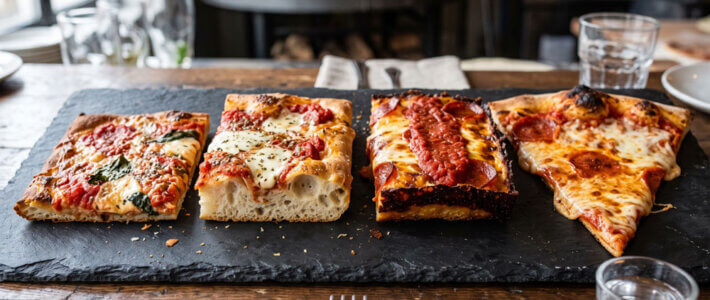
Pizza Styles Explained: Grandma vs Sicilian vs Detroit vs NY Slice
Ask four people from four different towns what a proper slice looks like and you will get four confident answers, plus a small argument. Pizza styles are like that. They carry hometown pride, family memory, and a surprising amount of opinion baked right into the crust. One person swears by a floppy triangle they fold in half on the walk to the car. Another will not touch anything that is not cut into squares. Both of them are right, which is honestly the fun part.
Here is the thing though. Most of us order the same thing over and over without ever knowing what separates one pie from another. We know what we like. We just cannot always say why. So let us walk through the four names that show up most often on menus around Morris County and work out what actually makes each one tick.
It Starts With the Pan, Not the Toppings
Before we get into individual names, there is one idea worth holding onto. The biggest differences here come down to two things: what the dough sits in while it bakes, and how long it rested beforehand.
A round pie baked straight on a hot deck behaves nothing like the same dough pressed into an oiled steel pan. Direct stone heat pulls moisture out fast and leaves you with a thin, crisp base. A pan does the opposite. It holds oil against the dough, and that oil essentially fries the bottom while the top bakes. Same flour, same yeast, same hands. Wildly different result.
Toppings matter far less than people assume. Pepperoni is pepperoni whether it sits on a triangle or a square. The pan is where the personality comes from, and once you know that, the rest of this makes a lot more sense.
Alright. Names.
The New York Slice: The One Everybody Pictures
When somebody says pizza with no qualifier attached, this is usually the mental image. Wide round pie, cut into eight generous triangles, thin enough through the middle that the tip droops if you hold it flat.
The dough is lean, meaning there is not much fat in the mix. It gets stretched by hand rather than rolled out, which leaves the outer rim thicker and airier than the center. Then it bakes hot and fast on a deck, usually somewhere north of 500 degrees. Sauce goes on light. Cheese is low moisture mozzarella, chosen because it browns instead of weeping water. The whole thing is engineered to be eaten standing up on a sidewalk.
That fold, by the way, is not a party trick. A slice this wide needs structural support to reach your mouth in one piece. Folding it lengthwise creates a channel that stiffens the whole thing. Basic engineering, really, and every kid in this state figures it out by age seven without being taught.
New Jersey has its own take on the round pie, which is close to its neighbor across the river but not identical. We pulled that apart in a separate piece on NJ pizza versus NY pizza if you want to go down that particular rabbit hole. Fair warning, it is a heated subject.
Sicilian: Thick, Square, and Older Than You Think
Now we cross into pan territory.
Sicilian traces back to sfincione, a spongy focaccia style pie sold by street vendors in Palermo, usually topped with onions, breadcrumbs, anchovies, and no mozzarella at all. The Italian American version that landed in Northeast pizzerias kept the shape and the height but got adopted into a cheese and tomato format that would probably confuse those original vendors a little.
What you get on a menu today is a rectangular pie roughly an inch tall. The crumb inside is open and bready, closer to focaccia than to anything cracker like. The bottom picks up a light fry from the oiled pan. Sauce often sits on top of the cheese rather than underneath it, which is not universal but is common enough to be a useful tell when you are trying to identify what showed up in the box.
A well made Sicilian square holds its shape when you lift it. If it flops in the middle, the dough was underproofed or the pan went into a cold oven. Small things, big consequences.
Worth flagging one point of confusion here. The thick double crusted pies you sometimes see around Easter are a completely different animal, closer to a savory layered pie than to pizza as most people understand it. That one has its own history and its own following, and we gave pizza rustica a separate writeup because lumping it in here would not do it justice.
Grandma Pizza: The Home Kitchen Cousin
Here is where people get tripped up most often. Grandma and Sicilian look similar at a glance. Both square. Both from a pan. But they are genuinely different pies, and the difference comes down to time.
Grandma pizza came out of Long Island home kitchens, made by Italian American women who did not own a deck oven and did not have three hours to let dough rise before dinner. So the dough goes into an oiled sheet pan and gets pushed toward the corners with fingertips, then bakes after a short proof or sometimes almost none at all.
That short rest changes everything. Less rise means a thinner, denser, chewier base. Maybe half an inch tall against the Sicilian full inch. And because the dough spends less time expanding, the oil in the pan crisps the bottom harder, so you get a real crunch that a Sicilian usually will not give you.
Sauce is typically dolloped rather than spread evenly, sometimes over the cheese, sometimes in loose stripes. Sliced fresh garlic and a finishing drizzle of olive oil show up far more often here than on other pan pies. The whole thing tastes homemade because it literally started out that way, in somebody kitchen, on a Tuesday.
It converts people. If you have never had one, that is the pie to try next. We put together a longer look at grandma pizza for anybody ordering their first one and wondering what to expect.
Detroit Style: Where the Cheese Meets the Wall
This is the newcomer on most Northeast menus, and it has been winning converts at a genuinely surprising rate over the last few years.
Detroit style started in automotive shops, baked in blue steel trays originally built to hold small parts on a factory floor. Those pans conduct heat aggressively and have straight tall sides, which sets up the defining feature of the entire style: cheese pushed all the way out to the edge, where it hits hot metal and caramelizes into a crunchy, salty, faintly bitter frame around the whole pie.
That edge has a name among people who care about this stuff. Frico. It is the single reason most people order the style, and it is why the corner pieces vanish first at every table, every time, without fail.
The interior runs light and airy, noticeably more so than a Sicilian, thanks to a wetter dough and a longer proof. Brick cheese is traditional, though plenty of kitchens use a mozzarella blend and nobody complains. And the sauce almost always goes on last, ladled across the top in stripes, which keeps the cheese from steaming and losing the crust it just worked so hard to build.
Round deck baking and square pan baking really are two separate crafts sharing one name. Our Detroit style writeup gets deeper into the pan specifics if that is the part that interests you.
A Side by Side Look at These Pizza Styles
Sometimes a table just says it faster than paragraphs do.
| Style | Base | Height | Sauce | Signature Trait |
| New York | Deck oven, no pan | Thin, about a quarter inch | Under the cheese | Folds without cracking |
| Sicilian | Oiled pan, long proof | Around one inch | Often over the cheese | Bready, focaccia like crumb |
| Grandma | Oiled sheet pan, short proof | About half an inch | Dolloped, often on top | Crisp fried bottom, fresh garlic |
| Detroit | Steel pan, high walls | Around one inch | Striped on last | Caramelized cheese edge |
So Which One Should You Actually Order?
Depends on the night, honestly.
Feeding a crowd where everybody wants something familiar and nobody wants to think about it? Round New York style, no contest. It travels well, it reheats fine, and you will not field a single complaint.
Want something that feels like an occasion rather than a default weeknight order? Detroit. That caramelized edge does not exist anywhere else on the list, and the first bite of a corner piece really is a different experience from the rest of the pie.
Looking for bready and comforting, the kind of thing that is somehow better cold from the fridge the next morning? Sicilian, easily.
Garlicky, crisp bottomed, a little rough around the edges in the best way? Grandma. It is also the one that most surprises people who were pretty sure they already knew what they liked.
One small tangent that matters more than it sounds. Pan pies need extra minutes in the oven compared to a round pie, sometimes eight or ten more. If you are ordering a mixed batch for a group and timing is tight, mention it when you call. A kitchen can sequence the bakes so everything lands hot at the same moment, but only if somebody tells them what the plan is. Same logic applies to any larger order, which is why the catering side of things usually runs on a day of notice.
One regular put it to us pretty plainly last month: “I ordered a grandma and a Detroit on the same night because my wife and I could not agree, and now we just do that every other Friday. Our kids fight over the corner pieces and I let them, because I already ate two before the box hit the table.” Our customers are really happy with the square pies, and the feedback we hear most is that people had no idea the two were different until they tried them side by side.
Reheating, Since Somebody Always Asks
Skip the microwave. It steams the crust from the inside and you end up with something limp and sad, which is a rough way to treat leftovers that were perfectly good eight hours ago.
Cast iron skillet, medium heat, lid on for roughly four minutes. The bottom re crisps while the trapped steam remelts the cheese without drying it out. Works for every style on this page, though the pan pies handle it best because there is simply more structure there to work with.
No skillet? Oven at 375 for about eight minutes, straight on the rack with a sheet of foil underneath to catch drips. Not quite as good, still miles ahead of the microwave.
Where All of This Actually Came From
Pizza itself has a much older and messier history than these four names suggest. The flatbread lineage stretches back centuries before tomatoes ever reached Europe, and the Neapolitan template that everything else descends from only really formalized in the 1800s. The full history of pizza is worth a read if you like that sort of thing, and the structured record of the dish maps out how the regional variations branch off each other.
Everything on this page is a branch off that same trunk. Which is sort of the whole point. There is no correct pizza. There is just the one that fits the night you are having, and the good news is that most kitchens around here will make you more than one of them.
If you want to see what that looks like in practice, the full menu lays out which shapes are available on any given day, and the loaded specialty pies are worth a look once you have settled on a shape you like.
Frequently Asked Questions
What is the difference between grandma pizza and Sicilian pizza?
Proof time, mostly. Sicilian dough rises longer in the pan, producing a taller, breadier square around an inch thick. Grandma dough is stretched into an oiled sheet pan and baked after a short rest or none, which gives a thinner, denser base closer to half an inch with a crisper fried bottom. Grandma also tends to carry sliced fresh garlic and dolloped sauce.
Is Detroit style pizza the same as deep dish?
No, and the two get confused constantly. Chicago deep dish is built like a pie, with a tall pastry style wall holding a deep layer of cheese and chunky tomato. Detroit is a pan pizza with an airy, focaccia like interior and a caramelized cheese edge. Detroit is about an inch tall. Deep dish can run two or three.
Why is New York pizza folded?
Structure. A slice cut from an eighteen inch pie is wide and thin enough that it will collapse under its own weight if you hold it flat. Folding it lengthwise creates a rigid channel so the tip stays up and the toppings stay put. It also happens to funnel any grease toward the tip instead of your sleeve.
Which style is best for feeding a large group?
Square pies win on math. A rectangular pan cuts cleanly into uniform pieces, which makes portioning simple and cuts down on the awkward last slice problem. Round pies are still the safer bet if the group includes kids or anybody who wants something familiar. Mixing both is usually the smart move.
Do these different styles take different amounts of time to bake?
Yes, and it is a real gap. A thin round pie in a hot deck oven can be done in six or seven minutes. Pan pies need fifteen to twenty because the heat has to travel through more dough and the cheese edge needs time to set. Order a mix and let the kitchen know when you want it all ready.
