A Slices and Sizing Guide for Any Crowd
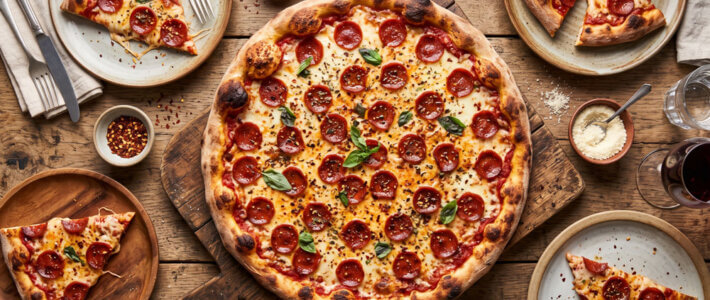
How Much Pizza Per Person? A Slices and Sizing Guide for Any Crowd
Twenty two people said yes to Saturday. You have a rough idea that pizza is the answer, and no idea at all how many pies that means. So you sit there doing napkin math, second guessing yourself, and eventually landing on a number that feels vaguely right. Figuring out how much pizza per person is one of those small planning problems that seems like it should be obvious and absolutely is not.
Order short and somebody goes home hungry. Order long and you are eating cold slices until Wednesday, which, fine, is not the worst outcome. But there is a real number here, and it is not complicated once somebody hands it to you. Let me walk you through it.
Start With the Rule of Three
The working assumption in most kitchens is three slices per adult. That is the number to build everything else on.
It sounds low if you are picturing yourself on a Friday night having a moment with a large pepperoni. It is not. Three slices from an eighteen inch pie is a genuinely substantial dinner, and once you factor in that some guests will eat two and a couple will eat five, the average lands where it always lands. Around three.
So the base formula looks like this. Take your headcount, multiply by three, divide by the number of slices in whatever size you are ordering. A large pie typically cuts into eight. So twenty adults times three slices is sixty slices, divided by eight, which is seven and a half pies. Round up to eight, always round up, and you are done.
That is the whole calculation. Everything from here is adjustment.
Slice Counts by Size, Because They Are Not Standard
This is where people go wrong most often. A large is not a fixed thing across shops, and the slice count matters more than the diameter number on the menu.
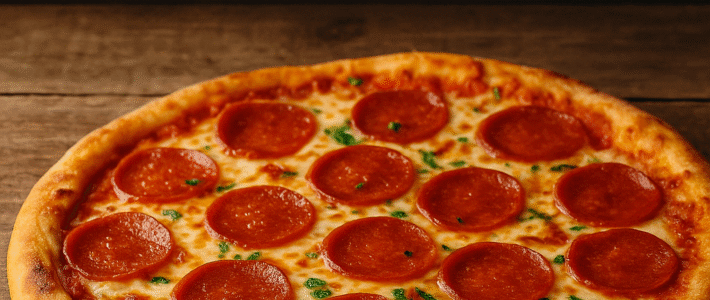
Round pies generally break down like this. A small runs twelve inches and cuts into six. A medium is around fourteen inches, also six or sometimes eight. A large is sixteen to eighteen inches and gives you eight. Extra large pushes past eighteen and can be cut into ten or twelve depending on the shop.
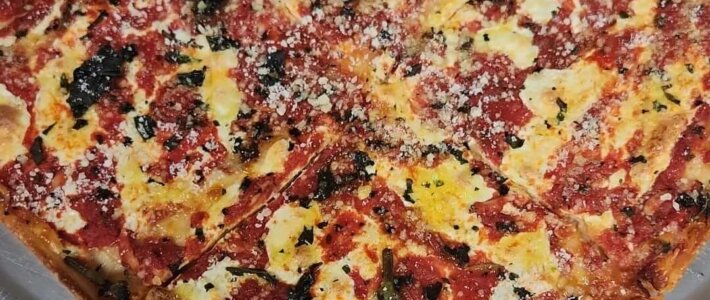
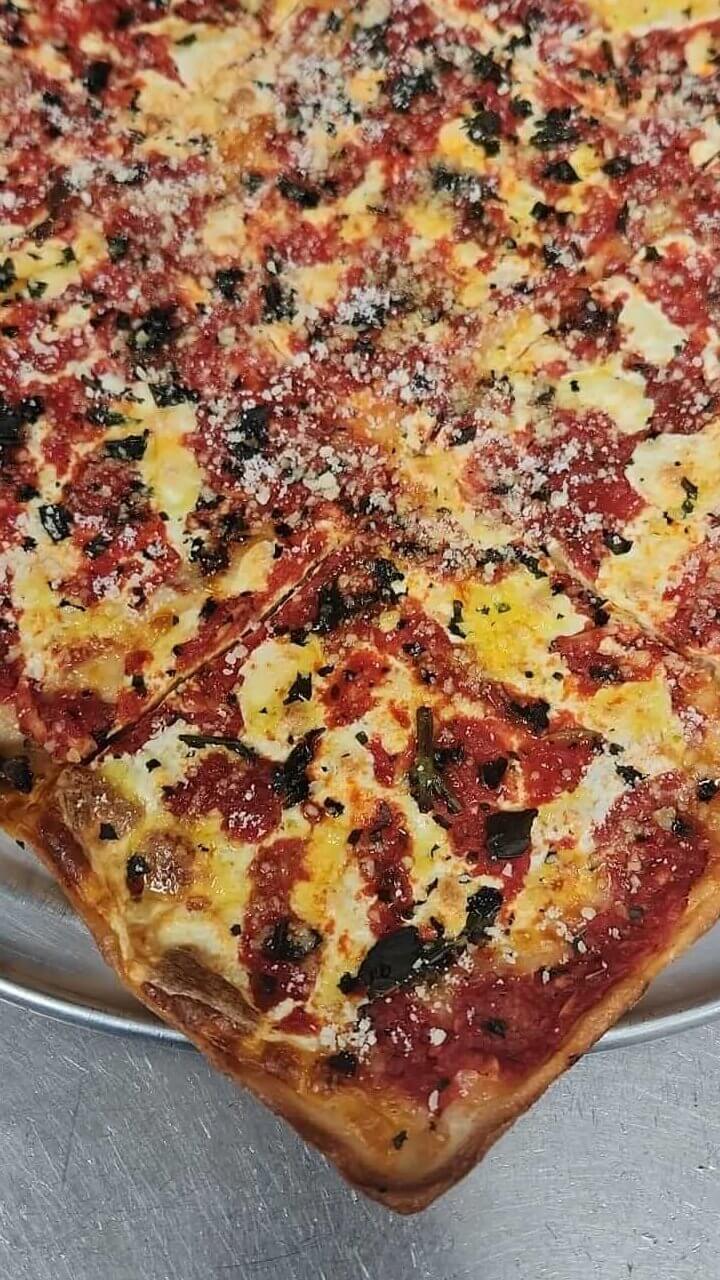
Square pan pies are different animals entirely. A full sheet or Sicilian tray typically cuts into twelve to sixteen squares, and those squares are heavier than a round slice because there is simply more dough per piece. Two squares of a thick Sicilian will fill somebody up faster than two triangles will. If you are ordering square, shade your per person count down slightly, to maybe two and a half.
Here is the part worth internalizing: two mediums are not the same as one large. Area scales with the square of the radius, so an eighteen inch pie has roughly twice the pizza of a twelve inch one, not one and a half times. Ordering larger is almost always cheaper per slice and less work for everybody. Ask what sizes are actually available before you build your order, since the menu will tell you what the cut looks like.
A Chart You Can Just Look At
If you skipped the math above, no judgment. Here is the answer laid out.
| Guests | Slices Needed | Large Pies (8 cut) | With Sides | Notes |
| 5 people | 15 | 2 | 2 | One large plus one small also works |
| 10 people | 30 | 4 | 3 to 4 | Add a salad and you can hold at 3 |
| 15 people | 45 | 6 | 5 | Good point to split styles |
| 20 people | 60 | 8 | 6 to 7 | Order two flavors minimum |
| 30 people | 90 | 12 | 9 to 10 | Consider square trays instead |
| 50 people | 150 | 19 to 20 | 15 to 16 | Call ahead, always |
The Adjustments That Actually Change the Number
The rule of three is a starting point, not a verdict. A few things move it meaningfully.
Kids eat less than you think
Count children under twelve as one and a half slices, not three. A room full of eight year olds will eat far less pizza than the same number of adults, and they will fill up on soda and chips in the first fifteen minutes regardless of what you planned. Birthday parties consistently over order for this reason.
Teenagers break every model
Count them at four or five. Sports team, post game, hungry sixteen year olds? Five, and consider six. This is the one demographic where over ordering is genuinely hard to do.
Sides pull the number down fast
Garlic knots, a big salad, wings, a tray of baked ziti. Any of these cuts your pizza count by roughly a quarter, because people fill plates with whatever is in front of them. If you are laying out a spread rather than pizza alone, drop from three slices to two and a quarter per adult and you will land close.
Time of day matters more than headcount sometimes
A lunch crowd eats less than a dinner crowd. An evening event where people arrive hungry at seven eats more than an afternoon thing where everybody had a late lunch. And a party running past ten at night will find a second wind and eat again, so hold something back if the night is going long.
Do Not Forget Who Cannot Eat What
This one gets skipped and it is the mistake with the highest cost, because the person affected notices immediately and there is no fixing it once the food arrives.
Ask about dietary needs when you send the invite, not the day of. In a group of twenty, odds are decent that at least one person is managing celiac disease or a serious gluten sensitivity, and that person will otherwise stand there eating chips while everybody else eats dinner. A gluten free diet is a medical requirement for a lot of people rather than a preference, and cross contamination in a shared kitchen is a real consideration worth asking about directly.
Order one dedicated pie and label it. Keep it on a separate table if you can. It costs you fifteen dollars and it means somebody actually gets to eat at your party. Local recommendations turn up regularly in threads like this discussion of gluten free spots around New Jersey, which is a decent place to see what other people in the area have had luck with.
Same logic for vegetarians. One cheese or veggie pie in any order over ten people, minimum, no exceptions. And if you already know somebody in the group needs it, our gluten free options page covers what is available and what to ask about when you place the order.
A customer who runs a youth program in Morris Plains told us how she handles it: “I used this as my standard now. Three slices for the coaches, five for the boys, one gluten free pie for our keeper, and I always add garlic knots because it stretches the order. I stopped guessing three seasons ago.” Our customers are really happy with how the larger orders come out, and the feedback we hear most is that calling a day ahead is what makes the difference.
Working Out How Much Pizza Per Person for Bigger Events
Past thirty people, the math stops being the hard part and logistics take over.
Round pies get awkward at volume. Twenty boxes take up an enormous amount of table space, they cool at different rates, and portioning them evenly across a long line is a nuisance. Square trays solve most of that. A Sicilian or grandma tray cuts into uniform pieces, stacks cleanly, holds heat longer because there is more mass, and eliminates the last slice standoff that happens with every round pie.
Ordering in waves helps too. For anything running more than two hours, split the order and have half arrive an hour after the first batch. Hot pizza at nine beats lukewarm pizza that showed up at seven and has been sitting since. Most kitchens will schedule this if you ask, and the larger order options page covers what that looks like in practice.
Give notice. A day is the standard ask for anything past four or five pies, and it is not a formality. A kitchen running a normal dinner service cannot absorb a twenty pie order without warning, and the result if they try is slower food for everybody including you. The catering side of most shops runs on that schedule for a reason, and for the full spread with pasta trays and salads alongside the pies, Italian catering is usually the better route than ordering pizza alone.
One last practical thing. Confirm your pickup or delivery time twice, once when you order and once the morning of. Timing is the single most common failure point on large orders, and a thirty second call fixes it. Hours and details are on the contact page if you need them.
The Three Mistakes People Make Every Single Time
After enough Saturday nights, the same errors show up over and over.
The first is ordering too many flavors. It feels generous. It is actually a problem, because a group of twenty presented with eight different pies will pick at the two popular ones and leave the mushroom pie almost untouched. Two or three varieties across any order is plenty. Cheese and pepperoni will carry most of the weight no matter what else you put on the table, and that is not a failure of imagination, it is just what people reach for.
The second is forgetting about drinks and plates. Not a pizza problem exactly, but it derails more parties than a slice shortage does. Count two drinks per person for anything running past ninety minutes, and get more napkins than feels sensible.
The third is treating the delivery window as a fixed point. It is an estimate, and on a Friday at seven it is an optimistic one. Give yourself twenty minutes of slack on any weekend evening order, or better, schedule pickup and send somebody. For anything over ten pies, pickup is frequently faster and gives you control over the timing, which matters when people are already sitting down.
Leftovers Are a Feature, Not a Failure
Round up. Always round up. An extra pie costs less than the awkwardness of watching the last three guests share four slices, and cold pizza the next morning is one of the genuinely good things in life.
Store it flat in the fridge, not stacked in the box, ideally with parchment between layers. Reheat in a dry skillet over medium heat with a lid on for four minutes rather than the microwave. The bottom crisps back up and the cheese remelts properly, which the microwave will never manage no matter how many times you try.
Frequently Asked Questions
How many slices does the average person eat?
Three slices for an adult is the standard planning figure. Children under twelve average one and a half, teenagers average four to five, and adults at a lunch event tend to eat closer to two. These are averages across a group rather than predictions about any individual, which is why they work for planning.
How many large pizzas do I need for 20 people?
Eight large pies cut into eight slices each, which gives you sixty four slices against a need of sixty. If you are also serving sides like wings, salad, or pasta, six or seven will cover it. If the group skews toward teenagers, go to ten.
Is it better to order two mediums or one large?
One large, almost always. Pizza area grows with the square of the radius, so an eighteen inch pie holds roughly twice as much as a twelve inch one rather than one and a half times. You get more food per dollar and fewer boxes to manage.
How far in advance should I order for a large group?
A day of notice for anything above four or five pies. Larger events running past fifteen pies benefit from two or three days, particularly on weekends. Same day large orders are sometimes possible but you are competing with regular dinner service for oven space.
Should I order square or round pies for a party?
Square trays are easier at volume. They cut into uniform pieces, stack better, hold heat longer, and portion evenly across a serving line. Round pies are the friendlier option for smaller groups and for kids. Mixing both is common and works well for groups above twenty.